Digital Networks Act: BREKO, BDEW and VKU call on the EU to safeguard competition and fibre investments
Joint press release by BREKO, BDEW, and VKU
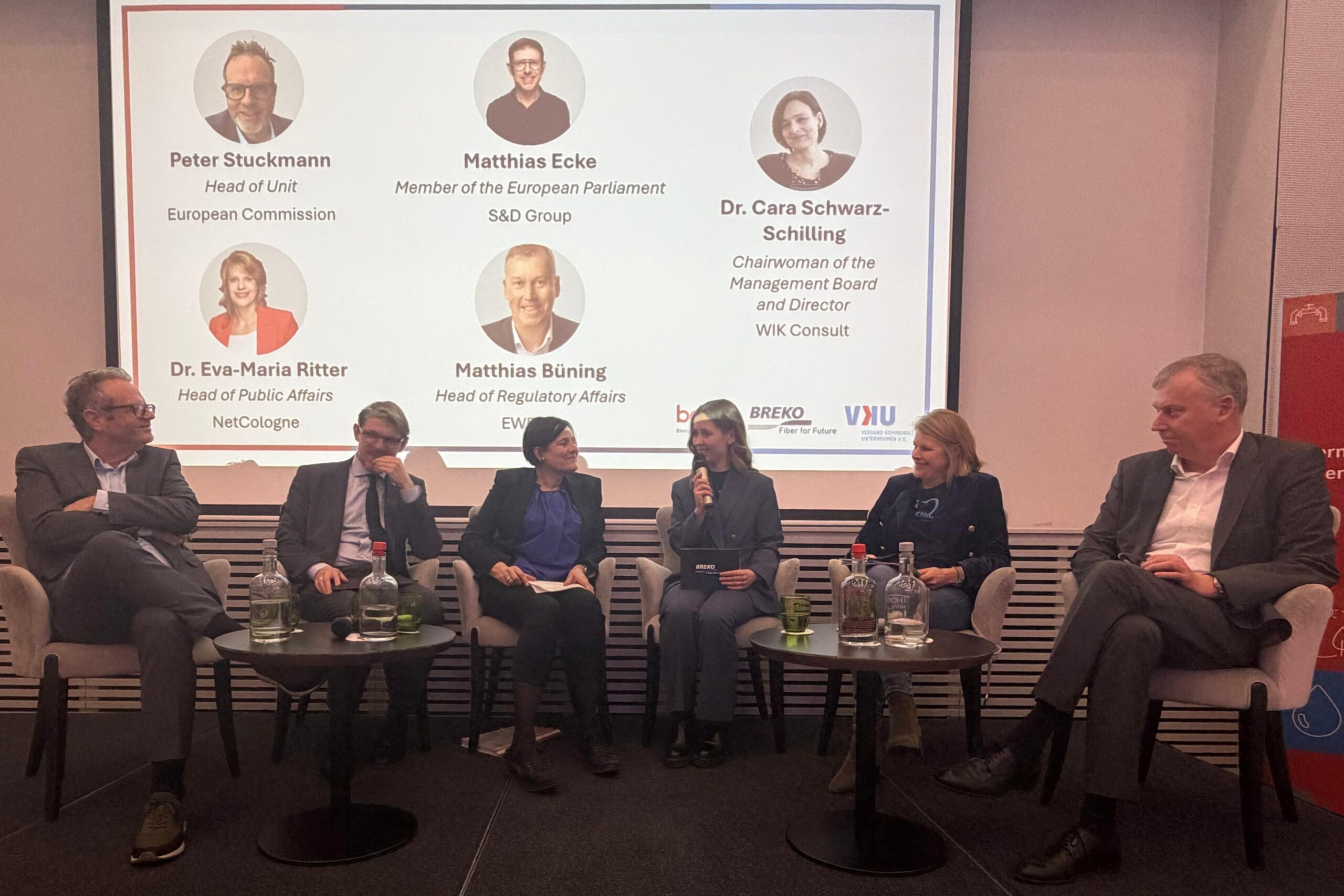
Brussels, 5 March 2026 – Today, the German associations BREKO, BDEW and VKU held a political event on the Digital Networks Act (DNA) in Brussels. They welcome the European Commission’s initiative as an important step towards modernising the EU telecom framework and supporting gigabit infrastructure deployment across Europe. At the same time, they underline that the DNA must reflect the diversity of Europe’s telecommunications markets – rather than paving the way for re-monopolisation – and that it must strengthen long-term competition, investment and innovation.
Representing over 90 percent of network operators active on the German telecommunications market and being responsible for around 70 percent of fibre deployment in Germany, BREKO, BDEW and VKU stress that only a diverse, competition-oriented market can ensure fair offers and prices for consumers and foster Europe’s digital sovereignty.
On the copper-to-fibre transition, the associations support the Commission’s intention to establish a rule-based framework – including sustainability considerations. However, they call for a fast, fair and workable approach that avoids undue delays. In particular, BREKO, BDEW and VKU consider a threshold of 85 percent premises passed in a given area to be sufficient for initiating the local copper switch-off process. They also emphasise that transition plans must be available early to provide planning certainty for operators, regulators and customers.
On competition safeguards and wholesale regulation, BREKO, BDEW and VKU commend the Commission for maintaining the existing regime of ex-ante regulation for operators with significant market power as a key tool to safeguard competition. They warn, however, that any introduction of symmetric regulation – especially when affecting passive infrastructure – must not undermine incentives for fibre roll-out. The associations further underline that the DNA should avoid regulatory uncertainty or devaluation of privately financed infrastructure, particularly during sensitive transition phases.
On spectrum policy, the associations highlight that Europe’s spectrum decisions are highly relevant not only for spectrum holders, but also for operators without spectrum holdings. Europe should avoid spectrum policies that disadvantage new entrants and fixed-mobile convergence (FMC) business models, and instead support innovation, regional solutions and scalable competition. Specifically, BREKO, BDEW and VKU caution that extended license durations and automatic renewals without effective access obligations risk entrenching scarcity and reinforcing incumbent advantages. Wholesale access obligations should be explicitly included in the DNA, rather than remaining a theoretical last-resort option.
About the associations
The German Broadband Association (BREKO) represents over 500 companies, including more than 260 network operators, which are responsible for over 60 percent of fibre coverage in Germany.
The German Association of Energy and Water Industries (BDEW) represents over 2,000 energy and water suppliers of all sizes. These companies have played a key role in the expansion of fibre optic infrastructure for years, as they invest in and operate networks across the board, including through subsidiaries and sister companies.
The German Association of Local Public Utilities (VKU) represents over 1,600 municipal utilities and municipal companies in the fields of energy, water/wastewater, waste management and telecommunications. Numerous member companies are involved in broadband expansion: 220 companies invest over € 912 million per year, thereby strengthening local digital services.
Press contact
BREKO Bundesverband Breitbandkommunikation e.V.
+49 30 58 58 0-416
presse@brekoverband.de
BDEW Bundesverband der Energie- und Wasserwirtschaft e.V.
+49 30 300 199-1174
presse@bdew.de
VKU Verband kommunaler Unternehmen e.V.
+49 30 58580-221
presse@vku.de


